Kindred Spirits: Eduard Lindeman
The Father of Adult Learning

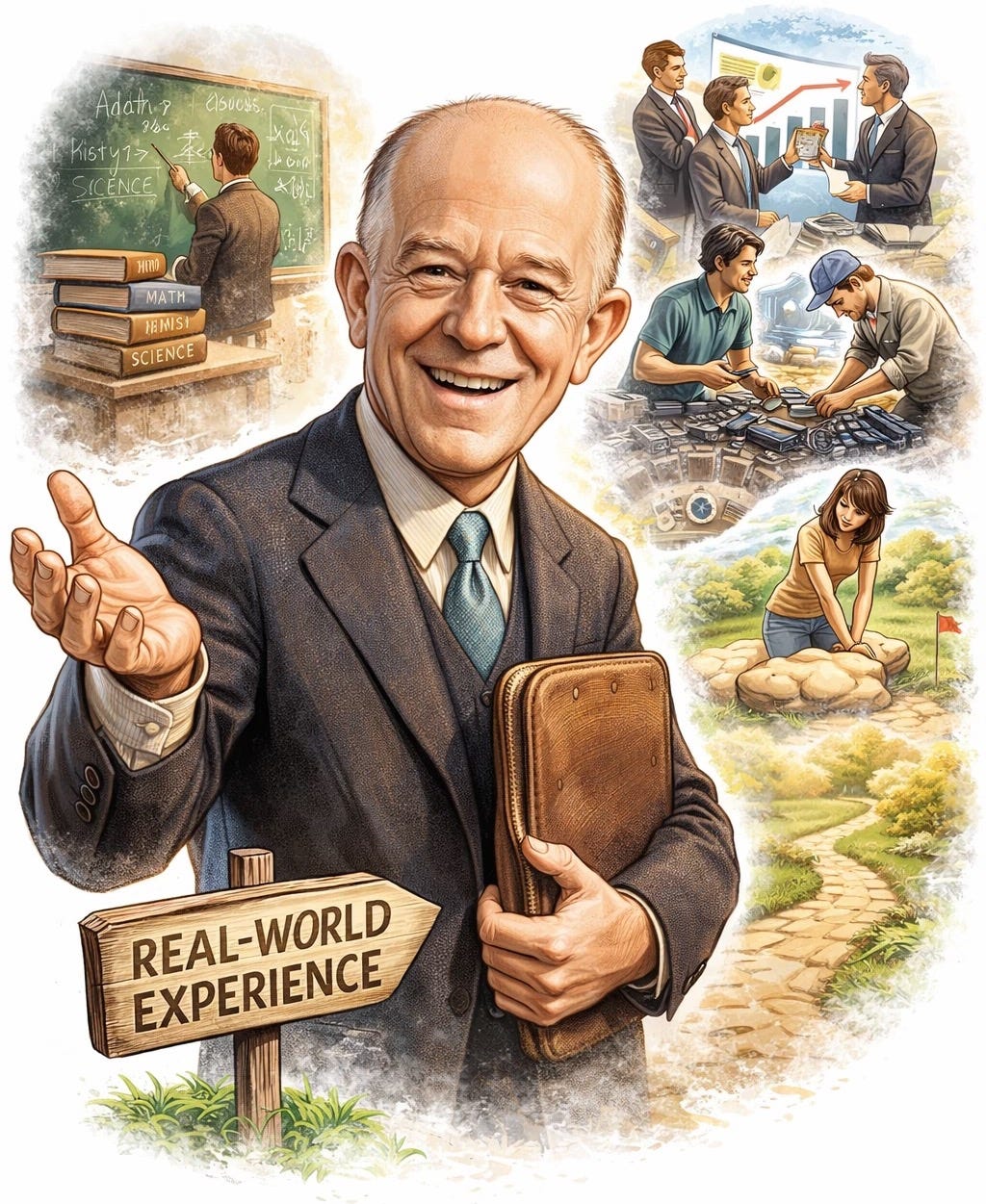
Picture, if you will, the roaring heart of the 1920s. It was a period defined by the relentless, grinding gears of rapid industrialisation, an era where the factory line threatened to reduce vibrant human beings into standardised, mechanical cogs. Amidst this clatter of mass production and societal upheaval, a profound philosophical rebel emerged. Eduard Lindeman was a man who looked at the rigid, sterile compartments of formal schooling and recognised a tragic disconnect from the beating heart of human existence.
When Lindeman published The Meaning of Adult Education in 1926, he did not merely write a book; he penned a vibrant, enduring manifesto for the human spirit. He sought to rescue the concept of learning from the dusty confines of the academy and the distant, disconnected halls of universities. Lindeman proposed a radical, beautiful premise: education is not a dreary preparation for a distant, future life; education is life itself. He saw that the true classroom is not bounded by four walls, but is rather the vast, unpredictable, and friction-filled expanse of our daily experiences.
What if the subjects you were forced to memorise in school were actually preventing you from understanding the complex, messy situations you must face in the real world?
From Subjects to Situations
When we examine the foundational architecture of Primed Adventuring, the intellectual fingerprints of Eduard Lindeman are unmistakable and profound. The most transformative connection between Lindeman’s philosophy and the methodology of Primed Adventuring lies in his brilliant distinction between the “subject-approach” and the “situation-approach” to learning.
In traditional educational paradigms, curricula are organised around established, siloed subjects, such as mathematics, history, or literature. Students are expected to passively adjust themselves to these predetermined compartments of what we refer to as biological secondary knowledge. However, Lindeman accurately observed that for the adult learner, this method is fundamentally flawed. Life simply is not lived in academic compartments; life is lived in situations.
When a Primed Adventurer steps into the unknown, they do not face a “history” problem or a “mathematics” problem. They face a sudden career disruption, a complex community conflict, or the terrifying existential friction of pursuing their inner calling. Lindeman argued that these very situations must become the starting point of the educational process. Instead of adjusting to a static syllabus, the individual must use education as a dynamic technique for listening to the “living textbook” of their own experience.
This directly mirrors the core tenet of Primed Adventuring: the rejection of assumed “general needs” prescribed by a distant institution, in favour of a curriculum driven entirely by the learner’s “immediate needs”. We champion the “community curriculum”, where the environment itself provides the unvarnished feedback required for growth. Just as Lindeman envisioned the educator shifting from a dispenser of facts to a guide who helps the learner analyse their reality, Primed Adventuring demands that the individual assumes the dual, active roles of both teacher and learner within their own life. We learn not by memorising subjects, but by aggressively deconstructing the situations we find ourselves embedded within.
We have traded the vibrant, unpredictable reality of the community curriculum for the sterile comfort of a syllabus. In doing so, we have forgotten how to learn from the very act of living.
A Debt of Gratitude
To what extent is the philosophy of Primed Adventuring grateful to Eduard Lindeman? The debt is immense. Lindeman provided the democratic and humanistic bedrock upon which our concepts of cognitive architecture and self-negotiated action are built.
We owe Lindeman a profound debt for redefining intelligence. He recognised that intelligence is not a static IQ score or a mere accumulation of trivial facts, but a highly functional tool for navigating the messy complexities of life with foresight. When we equip the Primed Adventurer with a “completion complex” of mental models, tools designed to read the environment, hypothesise solutions, and take deliberate action, we are directly operationalising Lindeman’s vision of functional intelligence.
Furthermore, Lindeman’s crucial distinction between “power-over” and “power-with” is the ethical heartbeat of our community-based tools. He recognised that true growth and democratic survival rely on cooperative, shared power rather than coercive, hierarchical dominance. When a Primed Adventurer utilises the mental model of “Coactions” to design symbiotic, mutually beneficial relationships, or when they use “Systems Convening” to invite diverse stakeholders into a shared learning space, they are practising Lindeman’s philosophy. They are actively transforming their status from powerless observers into active participants in a collective, creative enterprise.
Most importantly, we are grateful for his fierce defence of the whole human being. Lindeman warned against the “fractional personality” produced by modern specialisation, where individuals are reduced merely to their vocational functions, losing touch with their innate creative potential. Our archetype of the “Reasonable Adventurer”, an individual who cultivates intellectual flexibility, a breadth of interest, and a lively orientation toward meaningful action, is a direct continuation of Lindeman’s fight for human wholeness. He taught us that life is a “creative art” where the individual must remain the artist, constantly moulding their capacities to the fullest extent.
To graduate is not to finish learning; it is merely to lose the safety net of the institution. If you view education as a terminal point, you are already intellectually obsolete.
Lindeman’s Wisdom for the Everyday Adventurer
Why does Eduard Lindeman’s thinking from 1926 matter so urgently for you today? We are currently living in an era where the threat of the “fractional personality” is more severe than ever. In a world mediated by algorithms, artificial intelligence, and hyper-specialised career tracks, it is dangerously easy to become an “elderly-minded” passenger in your own life. We are frequently tempted to outsource our problem-solving to machines, bypassing the friction of learning entirely.
Lindeman’s philosophy offers a powerful, life-altering course correction. He challenges you to stop viewing your daily struggles, your workplace conflicts, your community issues, and your personal uncertainties as mere annoyances interrupting your life. Instead, you must begin to view these exact situations as your primary curriculum.
If you are feeling stuck or unfulfilled, Lindeman’s wisdom invites you to reclaim your education as a continuous, lifelong evaluation of your own experience. You do not need to wait for a formal classroom to become educated. You simply need to face the situation in front of you, identify the relevant facts, and synthesise your knowledge to resolve the problem. In doing so, you prevent the “atrophy of the mind” and remain a dynamic, highly capable participant in a rapidly changing world.
Moreover, Lindeman invites you to audit your relationships. Are you operating with “power-over”, trying to coerce outcomes and dominate your environment? Or are you cultivating “power-with”, embracing the “creative conflict” of social interaction to synthesise diverse viewpoints into a shared, robust understanding? By choosing the latter, you enrich not only your own cognitive architecture but the social fabric of your entire community.
Lindeman reminds us that the ultimate goal of learning is not the accumulation of certificates, but the continuous enrichment of the human experience and the realisation of our positive freedom. You are the artist of your own existence. Your life is the canvas, and your daily situations are the paint.
For your next adventure
If you are ready to move beyond the countdown and start building the cognitive architecture for a life of authentic satisfaction, I invite you to read Primed Adventuring: An Introduction (available on Amazon, or for free download HERE), or drop into the Primed Adventuring Skool community. But only if you are ready to receive lessons from living.